
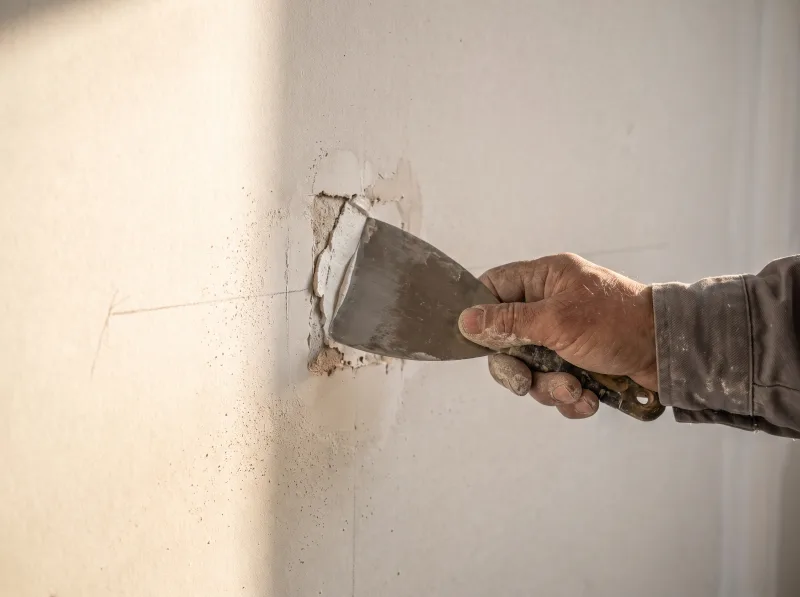
Small holes: nails, screws and wall plugs
Anything up to about the size of a five cent piece is a straightforward fill. The important part is not the filling — it is what happens after. Filler needs to be slightly proud of the wall, left to dry properly, then sanded back flush rather than wiped level while wet.
The step most people skip is priming. Dried filler is far more porous than the paint around it. Paint straight onto it and it soaks in, leaving a dull patch that is visible in side light even when the colour is a perfect match. A spot of primer or sealer first solves it.
Medium damage: dents, knocks and door handles
A dent has usually crushed the plasterboard rather than broken through. If the paper face is still intact, it fills like a small hole. If the paper has torn, the loose edges need trimming back first — filler over torn paper will lift.
Door handle damage is the classic case. It often looks like a hole but is really a crushed area with a hole in the middle, and it needs building up in two or three passes rather than one thick fill that will shrink and crack.
Larger holes: when a patch is needed
Beyond roughly five centimetres, filler alone has nothing to hold onto. It needs a piece of plasterboard cut in and supported, then jointed and sanded so the repair sits flush with the surrounding sheet.
This is where DIY repairs most often go wrong. A patch that is not properly keyed in will telegraph — you will see its outline through the paint within a few months as the house moves and the materials settle at different rates.
Cracks are a different problem
Hairline cracks above doors and windows are usually movement, and they will come back if they are simply skimmed over. The crack needs opening up so the repair has some body, and in some cases it is worth accepting that a moving crack will reappear and treating it as maintenance.
A crack that is growing, running diagonally across a wall, or opening at a corner is worth having looked at properly before painting over it.
When it is worth calling someone
If the hole is bigger than your hand, if the wall is a feature wall or a strong colour, or if the repair is somewhere with raking light — a hallway wall beside a window, for example — the finish matters more than the fill, and that is where an experienced painter earns their money.
It is also worth a call when you simply do not want to spend a weekend sanding. A few small repairs and a touch-up is a short job for someone who does it every week.